




Flour dust produced during milling is highly flammable and explosive, requiring dedicated extraction systems. In milling industries, the milling of grain and cereals generates large quantities of fine dust (flour, bran, grain) that can ignite in the presence of an ignition source (spark, flame or electrostatic charge). The flour is in fact a highly explosive organic powder[1], and in the past, accidents in Italian and foreign mills have claimed victims (e.g. 8 deaths in 1989 in Guardiagrele, 5 deaths in 2007 in Fossano)[2]. In addition to the danger of explosion, the inhalation of food dust can damage workers' health. For these reasons, air extraction (ventilation and dust collection) is crucial: it keeps work areas clean, protects machinery and ensures high hygiene standards.[3][4].
Why vacuum dust from a mill
An effective extraction system brings many advantages in an industrial mill:
- Reduces the risk of explosion: by eliminating suspended and ground flour deposits, the possibility of an explosive atmosphere forming is greatly reduced[3].
- It improves production efficiency: a dust-free environment means fewer machine breakdowns (mills, sieves, conveyors) and less downtime for maintenance[3].
- It increases the quality of the final product: by removing impurities and foreign grains, a purer and more consistent flour is obtained, without contamination from residual dust[3].
- It protects the health of employees: Clean air reduces the risks of respiratory diseases. In Italy, INAIL registers thousands of occupational respiratory diseases linked to the chronic inhalation of fine dust every year[5]. Ensuring an extraction system is not only a legal obligation, but also an investment in the health of workers.
In summary, Vacuuming dust in real time pays off in every respect[3][4]the standard itself emphasises its importance by stating that centralised vacuum cleaner systems maintain a “clean and hazard-free environment”, improving productivity, safety and product quality[4][3].
ATEX legislation and explosion prevention
National and European regulations impose strict safety measures for hazardous environments. The European Directive 1999/92/EC (ATEX “working environments”), transposed in Italy by Legislative Decree 81/2008 (Title XI), states that the employer must prevent the formation of explosive atmospheres, avoid sources of ignition and mitigate the damage of a possible explosion[6]. In practice, each mill must carry out a ATEX risk assessment, define hazardous areas and adopt an “explosion protection document” with the measures taken[6][7]. Equipment (motors, fans, sensors, vacuum cleaners) used in ATEX zones must be certified for use in explosive atmospheres[7].
Another regulatory chapter is the European Directive 2014/34/EU (ATEX “products”), transposed in Italy by Legislative Decree 85/2016, which requires all machinery intended for explosive environments to be designed and certified according to harmonised standards. In practice, vacuum cleaners and filters for a mill must bear the ATEX mark and have the appropriate category (e.g. category 1/3D or 2/3D) according to the level of risk (zones 20/21/22)[8][9]. In addition, UNI and CEI technical standards (such as EN 16009 for venting panels and CEI EN 60335-2-69 for extractor fans) define additional construction requirements (antistatic filters, earthing, flameproof containment flanges, etc.).
In summary: The law requires continuous and safe dust extraction, the use of ATEX-certified components and training of operators on the risks. Every extraction system must be designed and installed according to these rules to avoid heavy penalties and ensure overall safety[6][7].
Recommended preventive measures
In addition to legislative requirements, safety authorities suggest a number of complementary technical measures to avoid accidents. For example, the Department of Fire Services (DORS) recommends:
- Continuous localised ventilation, hoods and vacuum tubes to prevent the concentration of flour dust in the air from reaching dangerous levels[10].
- Dust detection systems with alarms and automations to isolate the line or block motors in the event of excessive accumulation[10].
- Automatic shut-off or dilution valvesexplosion-proof systems (e.g. insulating flaps or extinguishing nozzles) in the ducts that stop or dilute a possible flame front[11].
- ATEX electrical equipment: each motor, sensor, electrical cabinet must have ATEX marking and adequate IP protection rating[11][9], to avoid sparks.
Such measures integrated with suction keep risk levels within acceptable limits. It is indeed essential that, even after a possible ignition, explosion-proof systems (isolation valves, pressure relief valves flameless vent) prevent the propagation of the explosion in the plant[12][8].
Technical solutions and real cases
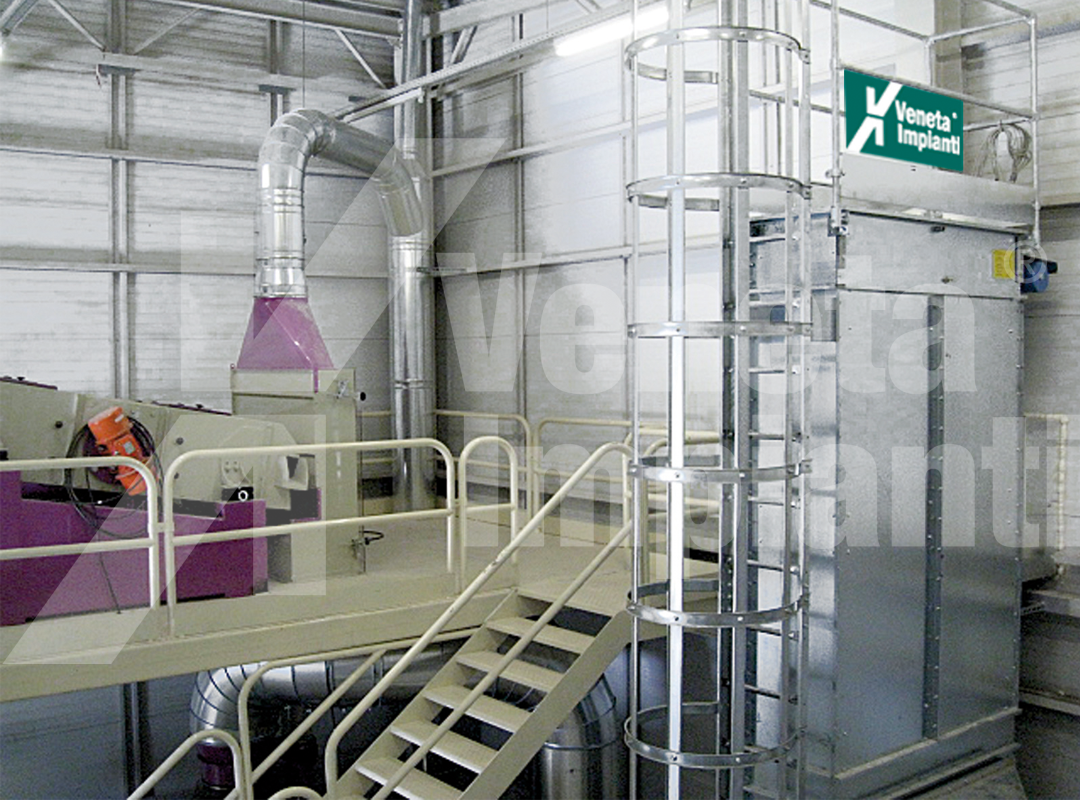
A suction system in a typical industrial mill consists of hoods or suction arms at the stations (discharge hoppers, sieves, grinders, packers), a network of sealed pipes and one or more centralised suction units. Self-cleaning bag filters collect the flour and, via augers or drains, convey the product into containers or Big-Bags, avoiding any dispersion. Suction units are sized according to air volume, but above all they must be ATEX certified and designed according to standards (e.g. explosion-proof motors, steel internal parts, earthing systems).
To understand how this translates into practice, a few cases can be cited:
- Centralised system for 5-storey mill (Poland): Depureco describes a plant with two main columns (one on each side of the building), each with one suction point per floor (10 points in total) plus 2 extra points, all connected to an ATEX-certified vacuum cleaner that collects grain and flour in its own container[13]. The system includes a subdivision valve which isolates a possible explosion and blocks the pressure inside the pipeline[12]. A similar example is documented in the Grandi Molini Italiani plant in Cordovado (PD): there, “all pre-cleaning machines, chain conveyors and bucket elevators” are connected to a central suction system with bag filters and dedicated fans[14], demonstrating that in large mills, suction is continuous at all process stages.
- ATEX vacuum units: many suppliers offer wheeled or stationary vacuum cleaners specific for combustible dusts. For example, the Depureco unit PUMA 15 (system shown below) is equipped with an 11kW ATEX side turbine, self-cleaning antistatic filters, stainless steel container and even a “Flameless Vent” to contain flames in the event of an internal explosion[8]. These safety features (ATEX 1/3D marking, non-sparking metal parts, controlled discharge systems) are indispensable for any vacuum cleaner used in a mill.
Figure: ATEX industrial vacuum cleaner for food dust in a mill. The components (motor, filter, exhaust) are designed for explosive atmospheres, with anti-static filters and flame arresters[8][9].
In general, a well-designed system includes shockproof valves/isolation flaps, localised dust drains, sensors and spark extinction and ATEX-compliant piping. Thanks to these integrated solutions, the working environment remains clean and safe, drastically reducing both production downtime and accident risks[4][14].
The added value of Veneta Impianti Srl
Rely on an experienced supplier such as Veneta Impianti Srl means having a suction system custom-made and fully compliant with regulations. Veneta's engineers analyse the mill layout, the type of grain and dust, the air volume and define ATEX zones, to offer turnkey solutions (centralised systems, mobile vacuum cleaners, filter systems). A plant designed by Veneta guarantees:
- Total security: ATEX-certified components and integrated explosion-proof systems (explosion isolation, vent valves) to protect people and the plant.
- Production efficiency: Reduction of downtime and maintenance through automated cleaning of the working environment.
- Regulatory compliance: full compliance with Legislative Decree 81/2008 and EU directives, with technical documentation and required markings.
- Continuous support: staff training and after-sales service ensure that the system remains performing over time.
Investing in an extraction system veneta therefore means not only fulfilling legal obligations (e.g. ATEX fire and explosion prevention), but above all improving the productivity and sustainability of the mill plant. A clean environment promotes more reliable processes and higher quality products: as reported in industry studies, a well-cleaned mill enables higher “overall production efficiency” and a purer end product[3][4]. Ultimately, Veneta Impianti's experience and expertise represent a strategic added value for any milling company.
Sources: indications of food dust hazards and ATEX measures from EU regulations and guidelines[6][7]; company case studies (Depureco and Grandi Molini plants)[13][14]; DORS guidelines for milling plants[10]; technical documentation from specialised companies[8][3].
[1] [3] [4] [8] [12] [13] Atex centralised systems for industrial mills - Depureco
[2] Microsoft Word - technical manual 2015_december.doc
[5] Dust Extraction: The Ultimate Choice That Puts Your Company First - Veneta Impianti
[6] [7] Risk of explosive atmospheres | EUR-Lex
[9] Combustible and explosive dust extraction - Depureco
[10] [11] Grain activities: how to guard against explosion risk - InSic
[14] Microsoft Word - summary_Grandi Molini Italiani Sesto al Reghena.doc